Seven Minutes, Whole Enough: The Case for the Partial Practice
There is a particular kind of disappointment that settles over a yoga mat when the promised hour does not materialise. The morning has already been claimed by emails, the evening by dinner, and the space between by the low-level tiredness that makes a full sequence feel less like care and more like another appointment. For many people in the UK, the obstacle is not a lack of interest in yoga. It is the belief that only a complete, uninterrupted, suitably long practice is worth beginning at all.
This is an understandable belief. Studio timetables are built around the hour. Online classes often assume a similar stretch of time. The language of practice can imply that depth requires duration, and that a shorter session is a compromise rather than a form of practice in its own right. But the body does not keep a stopwatch in the way the mind does. A few minutes of deliberate movement and attention can alter the tone of a day, even if the session would not fill a class timetable.
The hour is not the unit of care
A partial practice is not a failed full practice. It is a different entry point. Seven minutes of gentle movement gives the nervous system a chance to move out of the narrow, task-focused state that dominates so much of modern working life. It offers the shoulders somewhere to go after hours at a desk, the breath somewhere to settle after a rushed commute, and the mind a small, finite container in which to arrive.
The benefit is not measured by how closely the session resembles a studio class. It is measured by whether the body feels a little less braced afterwards, whether the breath is a little less shallow, and whether the next hour is met with slightly more room. That is not a consolation prize. It is the ordinary work of practice, scaled to the life that is actually being lived.
For readers in compact British homes, this matters. The living room may also be the office, the dining room and the place where the ironing board lives. Clearing a full hour for practice can feel unreasonable when the same space is needed for everything else. Seven minutes is easier to negotiate with reality. It asks less of the schedule and more of the attention.
A seven-minute living-room sequence
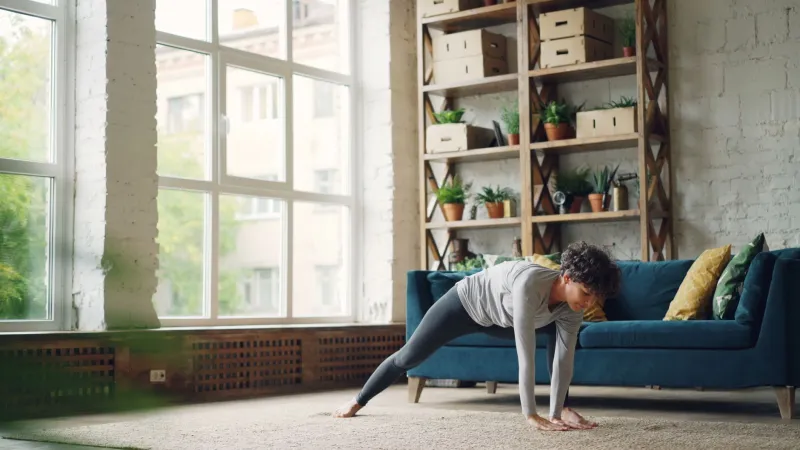
This sequence is deliberately modest. It can be done in everyday clothes, barefoot or in socks, beside a sofa or in front of a window. No special equipment is required. A folded blanket or a firm cushion may be useful, but it is not essential.
Minute one: standing arrival. Stand with the feet roughly hip-width apart. Let the arms rest by the sides. Feel the floor beneath the feet and notice the room around you. Take three or four slower breaths, allowing the exhale to be slightly longer than the inhale. There is nothing to achieve here. The aim is simply to stop leaving the previous task and start arriving in the body.
Minute two: shoulder and neck release. Roll the shoulders slowly a few times, then let them settle. Turn the head gently to one side and then the other, without forcing the range. Lift the shoulders towards the ears on an inhale and let them drop on an exhale. Repeat four or five times. Keep the movements small enough to feel unremarkable.
Minute three: side body. Raise one arm overhead and lean gently to the opposite side. Breathe into the long side of the ribs. Return to centre and repeat on the other side. Move slowly enough that the breath and the movement stay together. This is not a stretch to endure; it is a way of making space in the sides of the body after a day of sitting.
Minutes four and five: supported forward fold. Come to sit on a chair or on the edge of the sofa. Hinge forward from the hips and rest the forearms on the thighs, letting the head be heavy. If it is comfortable, rest the forehead on a cushion or the back of a chair. Stay for several slow breaths. Then come up gradually and pause.
Minute six: simple spinal movement. Sitting upright, move gently between a rounded and a slightly extended spine, allowing the breath to lead. Keep the range small. The purpose is not to stretch deeply but to remind the spine that it can move in more than one direction.
Minute seven: seated pause. Sit without doing anything further. Let the hands rest in the lap. Notice the breath without trying to change it. When the mind wanders, return to the feeling of the feet on the floor or the weight of the body on the chair. End by taking one slightly fuller breath and letting it go.
A framework for leaving all-or-nothing thinking behind
The difficulty with short practice is rarely the practice itself. It is the commentary that follows. The mind may insist that seven minutes is not real yoga, that it is too small to matter, or that it would be better to wait until a proper session is possible. These thoughts are familiar, but they are not instructions.
A useful framework is to treat the short practice as a complete unit rather than a fragment. Decide in advance that seven minutes is the whole session. Do not secretly expect it to become thirty. Do not add a second practice to compensate. Begin, move, pause, and finish. The completeness is in the boundaries, not in the length.
It also helps to attach the practice to something that already happens. Before the kettle boils. After the laptop closes. Before the evening meal is started. A fixed anchor reduces the need for motivation, which is often less reliable than routine. The practice becomes part of the hinge between one part of the day and the next.
Finally, resist the urge to turn rest into another task. A short practice is not a performance metric. It does not need to be tracked, scored, optimised or shared. If it becomes another item on a list of things that must be done well, it has lost the quality that made it useful. The point is not to achieve a perfect record of seven-minute sessions. The point is to offer the body a small, regular signal of care.
The day after a small practice
A partial practice will not solve every problem. It will not remove the pressures of work, the demands of family life or the particular tiredness that comes with a British winter. But it can change the way the next hour is met. It can make the shoulders a little less fixed, the breath a little less narrow and the mind a little less convinced that everything must be done in full or not at all.
Seven minutes is not a compromise with practice. It is practice, made to fit a real life. And a real life, with all its interruptions and unfinished edges, is exactly where yoga belongs.