The Quiet You Already Own: Reclaiming Rest in a Costly Winter

Rest has become curiously expensive. It arrives in the form of sleep trackers, subscription apps, weighted blankets, retreat deposits and candles with names like ‘stillness’. None of these things is inherently bad. But somewhere in the marketing of modern wellbeing, a simple human need has been repackaged as a purchase, and the implication is hard to miss: if you are tired, you have not invested properly in your own recovery.
That implication is especially uncomfortable in a cost-of-living winter. Energy bills, rent and food prices have made many households cautious about turning up the heating, let alone booking a restorative workshop. The result is a strange contradiction. Rest is more necessary than ever, and yet it is often presented as a luxury item with a checkout page. At Pacific Yoga, we think calm movement and recovery should be accessible in the home, not another subscription to justify.
When rest acquired a price tag
Wellness culture did not invent exhaustion, but it has become very good at selling solutions to it. The language is familiar: optimise your sleep, upgrade your evening routine, invest in your recovery. Each suggestion sounds reasonable in isolation. Taken together, they can suggest that rest only counts when it is planned, measured and paid for.
There is a particular irony in this for anyone living in a shared flat or a terraced house with thin walls. The ideal rest environment is often pictured as a silent, spacious room with a diffuser and a view of nothing in particular. Real homes are louder and smaller. They contain housemates, washing machines, traffic, neighbours and the low hum of a fridge. If rest requires perfect conditions, it will rarely happen. If rest can be made from ordinary conditions, it becomes possible again.
A free inventory for tired bodies
The first step is to stop treating free recovery as a lesser version of paid recovery. Lying on a rug for ten minutes is not a compromise. Sitting by a window without a screen is not a failure to meditate properly. Breathing without an app is not an incomplete practice. These are ordinary forms of rest, and they are available to most people without spending anything.
What follows is not a programme to complete. It is an inventory of small practices to return to when the body is tired and the wallet is closed. They can be done in socks, in old clothes, on a floor that is not especially clean, in a room that is not especially quiet.
Floor time without a mat
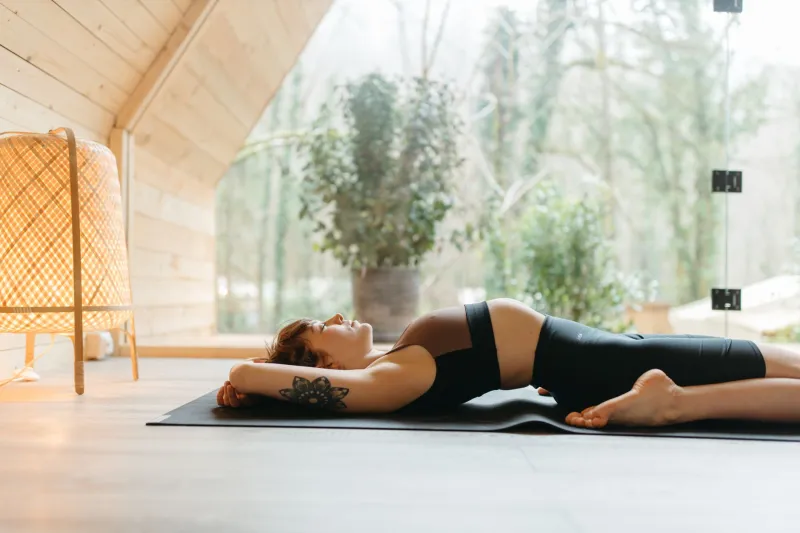
Floor time is one of the most underrated forms of recovery. Lie on your back on a rug or carpet, with a folded blanket under your head if you have one and another over you if the room is cool. Let the floor take your weight. You do not need to stretch, breathe in a special pattern or hold a pose. You are simply allowing the body to be supported by something other than effort.
Ten minutes is enough to begin with. If lying on the floor is uncomfortable, sit on a chair and rest your feet on a blanket instead. The principle is the same: change the shape of the body, let gravity do some of the work, and stop asking the mind to solve anything for a short while. If you fall asleep, that is information, not failure.
Window light and chair rest
Daylight is free, even in a British winter when it arrives late and leaves early. Sit near a window for a few minutes without a podcast or a phone. Let the light fall on your face if the weather allows it. This is not a treatment for anything; it is a way of reminding the body that the day has a texture beyond tasks.
Chair rest is similarly unglamorous and similarly useful. Sit with your back supported and your feet flat on the floor. Let your hands rest in your lap. Allow your shoulders to drop without forcing them. Stay for five minutes, or for as long as the room allows. In a shared home, a chair in a bedroom or at the kitchen table can become a small station for recovery. It does not need to look like a meditation corner. It only needs to be a place where you are not doing anything else.
Breath awareness, without an app
Breath awareness has been packaged into subscriptions, but it remains one of the most portable practices available. Sit or lie down and notice the natural breath. Do not deepen it or count it in a special sequence. Simply observe where you feel it: the rise of the chest, the movement of the belly, the coolness at the nostrils. When the mind wanders, return to the next breath. That is the whole practice.
If attention is difficult, place a hand on the lower ribs and feel the movement there. If you are anxious, keep the eyes open and let the breath be ordinary. There is no need to chase calm. The aim is to notice what is already happening, not to install a new state. A few minutes of this can be enough to make the body feel less like a problem to be managed.
A quiet window in a shared home
Privacy is a real constraint, and it deserves to be named. Not everyone can close a door. Not everyone can ask for silence. But many shared homes contain small windows of quiet: the twenty minutes before the first housemate surfaces, the gap after dinner, the walk between the bus stop and the front door. These windows are not ideal, but they are real.
It can help to make a quiet window visible to the people you live with. A folded blanket on the floor, a chair turned towards the window or a pair of headphones can act as a gentle signal. If a conversation is possible, say what you need: ten minutes without questions, not a whole evening. Protect the window by keeping it small and specific. A modest boundary is more likely to hold than an ambitious one.
The practice of enough
Rest is not a luxury purchase, and it is not a productivity hack either. It does not need to be earned by a hard day, tracked by a device or validated by a receipt. In a costly winter, the most useful recovery may be the kind that asks nothing of your bank account and very little of your time. Floor time, window light, chair rest, breath awareness: none of these will fix structural problems, but they can offer the nervous system a place to pause.
That pause is not indulgent. It is maintenance. And it is already yours.