The Carriage Between: A Late-Journey Practice for Coming Down Gently
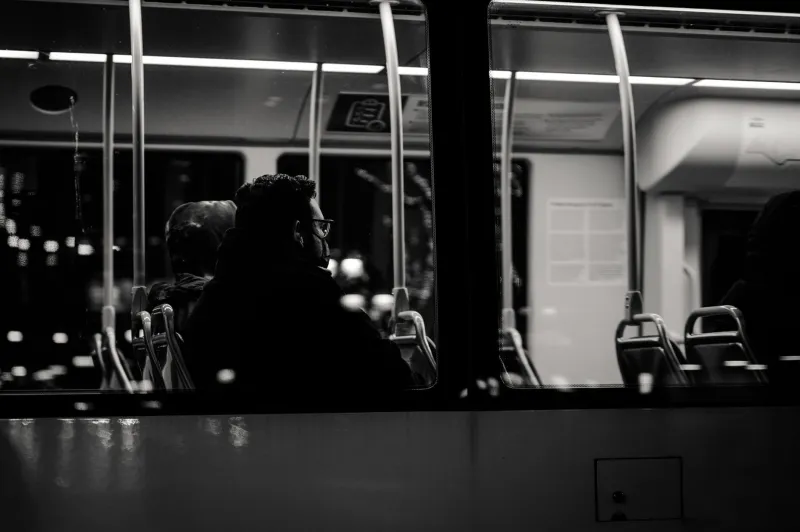
Late travel has its own atmosphere. The working day has been left behind, but home has not yet begun. Between the two sits the night bus, the last Tube, the rail replacement coach, or a near-empty carriage with its lights too bright and its heating too warm. It is not a place most of us associate with yoga. Yet it is precisely this in-between time that can benefit from a small, discreet practice.
At Pacific Yoga, we often return to the idea that practice need not wait for a mat, a studio, or a convenient hour. The last journey home is not an interruption to wellbeing; it is part of the day. What follows is a seated sequence for ordinary clothes and public transport: small movements for the jaw, shoulders, spine and hips, and a breath practice for softening the vigilance that late travel can bring. It is intended to be quiet, unremarkable and kind to a tired body.
Why Late Travel Asks Something Different
Evening journeys ask the body to remain alert after it has already given a great deal. There is the platform to watch, the stop to listen for, the fellow passenger to notice, the phone to check. This is not necessarily stress. It is vigilance, and it has its place. The difficulty is that the body can carry that vigilance all the way to the front door, long after the journey has ended.
The aim of this practice is not to switch off or to ignore one’s surroundings. It is to step down gently: to reduce unnecessary tension while remaining aware. On a bus or train, discretion matters. Every movement below can be made small enough that no one else need notice. If a movement does not feel right in the space available, it can be simplified or left out.
Begin With the Jaw
The jaw is a useful place to start because it often holds more of the day than we realise. Sit as comfortably as the seat allows, with the back supported if possible. Let the teeth part slightly. Allow the lips to close without pressing. Rest the tongue softly behind the upper front teeth, or simply let it lie still.
Notice whether the jaw is set. Then, without forcing, let the lower jaw hang a little heavier for three natural breaths. You might trace a small circle with the jaw, or gently massage the hinge just in front of the ears with the fingertips. Keep the touch light. The intention is not to stretch the face but to remind it that the day’s performance is over.
Shoulders That Have Carried the Day
Bring the shoulders up towards the ears on an inhale, then let them drop on the exhale. Repeat three times, making the movement smaller each time until it is almost invisible. Then roll one shoulder slowly forward and back, and change sides. Let the arms rest in the lap rather than folding them tightly across the chest.
If the carriage is quiet, tilt one ear gently towards the same-side shoulder and pause for two breaths. Return to centre before changing sides. There is no need to stretch to the point of visibility. A small, honest movement is enough. The shoulders often release more readily when they are not asked to perform.
A Small Movement for the Spine
With both feet on the floor and hands resting on the thighs, begin to rock the pelvis very slightly forward and back. As the pelvis tips forward, let the lower back lengthen. As it tips back, allow a gentle rounding. Keep the head still if you would rather not draw attention. Continue for four to six slow rounds, letting the movement become smaller rather than larger.
From there, bring the spine back to centre and imagine a little more space between the base of the ribs and the hips. There is no need to sit up straighter than is natural. The spine responds well to suggestion. A subtle lengthening, repeated without strain, can do more for a tired back than an ambitious posture held for appearance.
Hips, Even in a Bus Seat
Hips are often the first place to complain on a late journey. If space allows, sit slightly forward and place one ankle across the opposite knee, allowing the knee to fall open gently. If that is not practical, simply lift one foot a little and rotate the ankle, then change sides. You can also make small circles with the pelvis, as though tracing a coin with the sitting bones.
Keep the breath easy throughout. If a hip feels pinched or irritable, reduce the range or stop. Public transport is not the place to test a joint. The purpose is to interrupt stillness, not to create a stretch. Even a few small shifts can help the body feel less fixed by the time the stop arrives.
The Breath of the Return
Once the movements have settled, bring the attention to the breath without changing it at first. Notice where it is felt: at the nostrils, in the chest, or in the rise of the lower ribs. Then, if it feels comfortable, allow the exhale to be a little longer than the inhale. There is no need to count rigidly. A soft inhale and a slightly fuller exhale are enough.
This is not a switch that forces relaxation. It is an invitation. If the breath catches or the mind becomes busy, return to the natural breath and begin again. You might also let the eyes move slowly to three points in the carriage, then allow the gaze to soften. The breath and the gaze together can tell the body that the journey is contained, even when the evening has been long.
Arriving Before You Arrive
In the final few minutes of the journey, stop the movements and sit quietly. Feel the feet on the floor. Notice the temperature of the air, the sound of the engine, the weight of the bag beside you. Choose one small thing to carry home: an unclenched jaw, softer shoulders, a little more space in the spine. There is no need to arrive home perfectly regulated. The aim is simply to arrive a little less braced.
As you leave the bus or train, let the practice continue into the walk to the door. A slower pace for the final few metres can be surprisingly useful. At the door, pause before reaching for the keys. One breath, taken without hurry, marks the end of the journey and the beginning of the next part of the evening.
A Practice for the Ordinary Commute
Late travel is rarely glamorous. It is a seat under fluorescent light, a bag on the lap, a stop to watch for. But it is also a genuine transition, and transitions deserve care. This seated sequence can be done in ordinary clothes, in almost any carriage, without announcing itself. It asks for no equipment and no particular flexibility.
If you try it, keep the movements small and the breath unforced. Use it on the nights when the journey home feels longer than it should. The practice is not a substitute for medical advice, and any movement that causes pain should be stopped. But within those ordinary limits, the last journey back can become something more than a wait between places: a quiet carriage between one part of the day and the next.