The Convalescent Mat: A Patient Return to Yoga After a Winter Cold
There is a particular week in a British winter when the cold has loosened its grip but has not quite let go. The tissues are no longer needed quite so often, the kettle is visited less, and the thought of rolling out a mat returns. Yet the body may still feel thin-edged and unreliable. The urge to return to a familiar practice is understandable, but it is worth treating this in-between period as its own kind of practice: not a failed return to fitness, but a convalescence.
The In-Between Days
After a viral cold, the acute symptoms may settle before the body feels itself. Sleep can remain disturbed, the breath can feel shallow, and ordinary tasks may carry an unexpected weight. This is not a sign that you are being overly cautious. It is simply the body asking for a different pace.
Yoga can be useful here, provided it is offered as care rather than correction. The aim is not to test the system or to prove that you are over it. The aim is to restore circulation, confidence and breath, in small amounts, with attention. If you have an underlying health condition, are pregnant, or are recovering from a more serious illness, speak to your GP before returning to exercise.
Begin With the Breath, Sitting Down
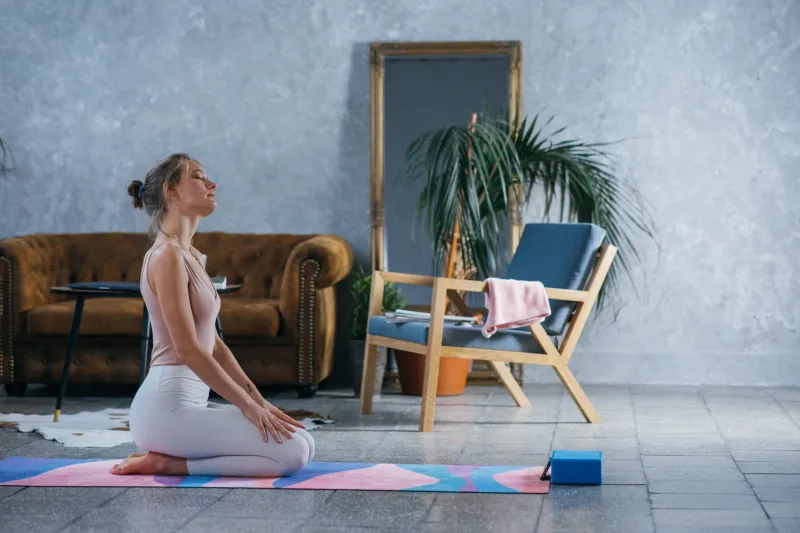
The first return does not need to happen on a mat at all. A firm chair, a cushion on the floor, or the edge of the bed will do. Sit with the feet grounded and the spine upright without strain. Place one hand on the lower ribs and the other on the belly. Let the inhale arrive through the nose, without forcing it. Let the exhale be slightly longer, as though you are fogging a window slowly.
Continue for five or six breaths. There is no need for breath holds, counting games or elaborate ratios. The purpose is to remind the nervous system that breath can be unhurried. If you feel dizzy or light-headed, stop and return to normal breathing. In a centrally heated flat, keep a glass of water nearby; winter air can be drying, and the body often needs more fluid than it registers.
Mobilise Before You Flow
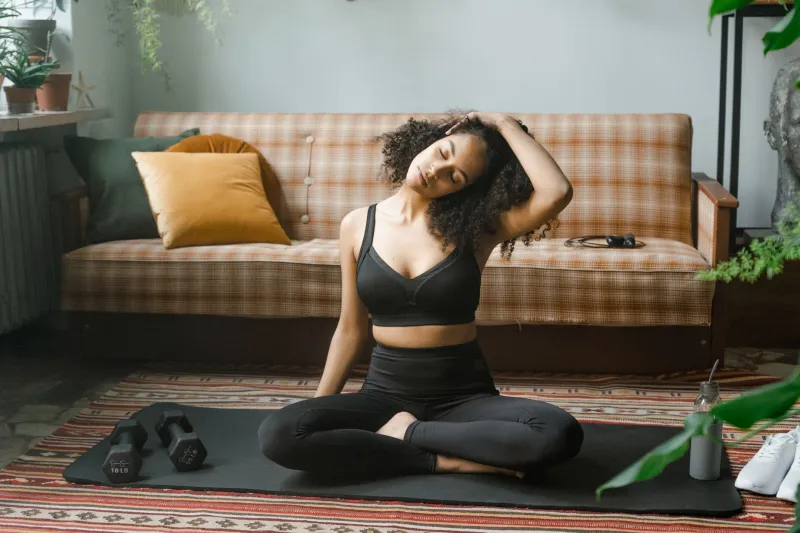
When you are ready to move, begin with the joints rather than the large muscles. Gentle mobilisation is a way of checking in rather than warming up for something bigger. Turn the head slowly from side to side, then let the shoulders roll forward and back. Circle the wrists and ankles. Let the spine move in a seated cat-cow, arching and rounding within a comfortable range. Add a soft side bend to each side, perhaps resting a hand on the seat of the chair.
Movement should feel like oiling a hinge, not testing it. If a joint complains, reduce the range. If a movement brings on a cough or a wave of fatigue, pause. The body is not a machine that can be overridden by intention, and the convalescent practice is built on listening rather than pushing.
A Ten-Minute Convalescent Sequence
A short sequence is enough for the first week or so. Try the following every other day, or whenever energy allows, and keep it to around ten minutes.
- Seated breath: two minutes of unhurried breathing, with a slightly longer exhale.
- Neck and shoulders: slow turns, half-circles and shoulder rolls for two minutes.
- Seated spine: cat-cow and gentle side bends for two minutes.
- Supported standing fold: stand beside a chair, rest the forearms on the seat, and fold only as far as feels comfortable. Stay for three or four breaths, then rise slowly.
- Rest: lie down with the legs resting on a chair or up the wall, or simply take a supported savasana for three minutes.
This is not a template to complete. It is a shape to return to. If you feel worse twenty-four hours later, shorten the next practice. If you feel steady, repeat it before adding anything new.
The All-or-Nothing Trap
The most common mistake after a cold is the belief that a strong practice will clear the remnants away. A vigorous flow, a hot yoga class or a long walk followed by a demanding sequence may feel satisfying in the moment, but it can also deepen fatigue. Sweat is not a measure of recovery.
Think in terms of a gradual return to load. A ten-minute practice done kindly is more useful than an ambitious one abandoned halfway through. The same principle applies to the commute, the school run and the weekly shop. The body is rebuilding its reserves, and those reserves are spent by ordinary life as well as by exercise.
When to Stop and When to Wait
Stop and rest if you experience chest tightness, dizziness, unusual breathlessness, a return of fever, or a feeling that your body is being pushed beyond its current capacity. Do not practise with a fever. It is also sensible to wait until you have had twenty-four hours without fever before returning to even gentle movement.
If a cough lingers, if breathlessness persists, or if fatigue does not improve over a week or two, seek advice from your GP. This is not alarmism; it is the same principle as checking a weather forecast before a winter walk. Some conditions deserve a professional eye.
Rest Is Part of the Return
Recovery is not only what happens on the mat. It happens in sleep, in hydration, in daylight and in the small decision to stop before you are emptied. A restorative pose, a blanket over the legs and a few minutes of quiet can be as valuable as any sequence.
The convalescent mat is a modest place. It asks for less than you might want to give, and it offers something quieter in return: a way back to movement that does not require you to pretend you are already well.